I am morally obliged to be a vegetarian because I believe non-human animals should be granted personhood since they are adequately aware of their basic needs, have the ability and complexity to exist as individuals, are conscious enough to be concerned for themselves and others and are able to survive and triumph without the interference of human beings. This means non-human animals should be granted the basic rights human beings also have like the right to be free from exploitation, cruelty, neglect, suffering, and abuse. Non-human animals should live in an environment that satisfies their basic physical and psychological needs. They should exist in their natural habitat, safe from extinction and the impact of humans. They should also have the right to be free from experimentation and research preformed by humans since they cannot consent to such treatment. Lastly, they should have their rights and interests represented in court and safeguarded by the law. This means, as a human being, I do not have the right to consume animals or use them only to benefit myself because I recognize doing so hurts more beings than it benefits.
As a vegetarian, I stand for equal treatment between human beings and non-human animals. I encourage others to recognize human superiority over other animals is called speciesism and is deemed unethical. To inflict pain and suffering unto other beings just because humans can does not mean we should. In fact, supporting vegetarianism also advocates education and awareness about the current treatment of animals in slaughterhouses, research facilities, zoos and aquariums, as companion animals, as subjects of possible extinction, and as persons capable of experiencing pain, emotions, and consciousness. I do not think anyone has to right to take the life of a living being whether he or she is a human or a non-human animal because, in the end, we are all made up of the same parts; a brain, a heart, a soul.
My question: Where do you stand on the subject?
Monday, December 13, 2010

Sunday, December 12, 2010
Book Review on Slaughterhouse: A Preview.
For my book review, I chose to read Slaughterhouse: The Shocking Story of Greed, Neglect, and Inhumane Treatment inside the U.S. Meat Industry by Gail A. Eisnitz. The author is the chief investigator for the Humane Farming Association and her book gives readers a very startling and disturbing inside look to U.S. slaughterhouses. She began her investigation at Kaplan Industries where she found, through endless interviews with staff and the public, that animals were being slaughtered fully conscious. She also visited John Morrell & Company in Iowa and Carolina Food Processors to confirm the notion that animals and the company employees are both being abused. This is the first book to explore the impact that changes such as industry consolidation, increased line speeds, and deregulation in the meatpacking industry, over the last twenty-five years, have had on workers, animals, and consumers. It is also the first time workers have spoken publically about what is really happening behind the closed doors of America’s slaughterhouses.
However, the public doesn't really know what is happening in these slaughterhouses because workers could lose their jobs if they spoke out and employers don't want to welcome the chance of receiving more standards and regulations in the slaughterhouses which would decrease profits. Animals are transported hundreds of miles in harsh conditions just so their lives could end for our desire to have meat for dinner. Eisnitz still manages to remain objective during her research and is able to describe and investigate the treatments of cows, pigs, chickens, horses, sheep, goats, and so on. Once I finished reading the book, my desire to ever eat meat again was gone because the author describes in such detail what happens to these animals through the voices of the workers and the consumers who have suffered illnesses and who even have had family members or friends die because of unhealthy conditions and carelessness in the industry.
I won't go any farther because I want to keep your interest for when I present. I do think everyone needs to read this book in order to know the truths behind the industry. Even though some of it may be hard to get through, being aware of what is happening behind our backs is enough of an incentive for me. I guarantee you will not believe what you are reading at first but the author makes sure to have enough evidence from a variety of sources as to how such an industry can control and full our country.
My question: I was wondering what views students have about the meat industry currently? When you hear the word "slaughterhouse" or the meat industry, what conditions and practices do you imagine? What do you already know?
However, the public doesn't really know what is happening in these slaughterhouses because workers could lose their jobs if they spoke out and employers don't want to welcome the chance of receiving more standards and regulations in the slaughterhouses which would decrease profits. Animals are transported hundreds of miles in harsh conditions just so their lives could end for our desire to have meat for dinner. Eisnitz still manages to remain objective during her research and is able to describe and investigate the treatments of cows, pigs, chickens, horses, sheep, goats, and so on. Once I finished reading the book, my desire to ever eat meat again was gone because the author describes in such detail what happens to these animals through the voices of the workers and the consumers who have suffered illnesses and who even have had family members or friends die because of unhealthy conditions and carelessness in the industry.
I won't go any farther because I want to keep your interest for when I present. I do think everyone needs to read this book in order to know the truths behind the industry. Even though some of it may be hard to get through, being aware of what is happening behind our backs is enough of an incentive for me. I guarantee you will not believe what you are reading at first but the author makes sure to have enough evidence from a variety of sources as to how such an industry can control and full our country.
My question: I was wondering what views students have about the meat industry currently? When you hear the word "slaughterhouse" or the meat industry, what conditions and practices do you imagine? What do you already know?
Last Response: To Nicole on Vegetarianism.
Response #23
In Nicole's blog, she responded to Becca's question about whether vegetarians ought to abstain from eating eggs and dairy products as well as the idea of red meat vegetarianism and pescatarianism. Nicole believes that if a person has their own home, buys their own food, prepares their own meals, has enough money and resources to be knowledgeable about the meat industry, and is in good health, then they should choose a vegan lifestyle and live their lives completely meat and animal product free. However, it's not so easy for a lot of people who do not have the money, the resources, the knowledge or the ability even if they wanted to. There are many types of vegetarians; those that only consume animal products but no actual meat to those that only consume chicken but no other animal to the people that just choose to not eat red meat. To be a complete vegan is tough because many products are made from animals which we do not even realize. Such a lifestyle would have to be strictly enforced and thought about on a regular basis. Nicole also stated that being anything more can an octo-lacto vegetarian on campus would be nearly impossible because of the meal plan we are forced to endure and the lack of true vegan options as well as money to buy our own food. Anyone who chooses some sort of vegetarian lifestyle is taking a step in the right direction even if they are consuming or using some animal products, according to Nicole. She then asks, "Why do you think there are so many misconceptions about vegetarianism, like that it is unhealthy or that people go through meat-withdrawals?"
I think it is because people feel threatened that they will have to change their ways so they buy into these fallacies just to convince themselves that vegetarianism is an impossible idea. People like the taste of animal flesh but they don't like to think about what it actually is. In my experiences, people advocate against vegetarianism because they see humans as natural predators who are meant to eat meat. To them, it's natural. It's something they do not think about and do not want to end. The responses I get when I tell people I am a vegetarian are that meat tastes too good, or that plants have feelings to, or our ancestors ate meat and our bodies are created to do so as well. I think it also might be because people do not generally accept what is different because they may not understand it. They might have all of these misconceptions because they never took the time to become more aware about cruelty to animals and a vegetarian lifestyle. They acknowledge whatever negative critiques they hear about because vegetarianism is not universally accepted in our society. They may also focus their opinions around what they see PETA and other extreme animal rights groups doing so their opinions are biased. People do not want vegetarians to force their beliefs on them so they stay narrow-minded and look for any reason to dismiss such a lifestyle. However, I'm not saying all omnivores are like this. I have met some people who respect my views but still enjoy meat for dinner.
Finally, I have found that when people ask me why I am a vegetarian and I respond with my own personal feelings which do not accuse or try to convince them to go vegetarian, I get respect even if they do not agree with my choice. I think it is important for everyone to be aware and educated about the meat industry, other cruelty to animals, and the abilities animals have. Only then can people truly make educated decisions whether to consume animals and animal products or not. I think the lack of education is the largest problem of the many misconceptions and negative attitude towards vegetarianism.
My final questions: Do you think children are capable of making the decision of whether to consume animals or not? Also, if children knew at a young age what they are eating once had a life, would they make the choice not to consume meat?

In Nicole's blog, she responded to Becca's question about whether vegetarians ought to abstain from eating eggs and dairy products as well as the idea of red meat vegetarianism and pescatarianism. Nicole believes that if a person has their own home, buys their own food, prepares their own meals, has enough money and resources to be knowledgeable about the meat industry, and is in good health, then they should choose a vegan lifestyle and live their lives completely meat and animal product free. However, it's not so easy for a lot of people who do not have the money, the resources, the knowledge or the ability even if they wanted to. There are many types of vegetarians; those that only consume animal products but no actual meat to those that only consume chicken but no other animal to the people that just choose to not eat red meat. To be a complete vegan is tough because many products are made from animals which we do not even realize. Such a lifestyle would have to be strictly enforced and thought about on a regular basis. Nicole also stated that being anything more can an octo-lacto vegetarian on campus would be nearly impossible because of the meal plan we are forced to endure and the lack of true vegan options as well as money to buy our own food. Anyone who chooses some sort of vegetarian lifestyle is taking a step in the right direction even if they are consuming or using some animal products, according to Nicole. She then asks, "Why do you think there are so many misconceptions about vegetarianism, like that it is unhealthy or that people go through meat-withdrawals?"
I think it is because people feel threatened that they will have to change their ways so they buy into these fallacies just to convince themselves that vegetarianism is an impossible idea. People like the taste of animal flesh but they don't like to think about what it actually is. In my experiences, people advocate against vegetarianism because they see humans as natural predators who are meant to eat meat. To them, it's natural. It's something they do not think about and do not want to end. The responses I get when I tell people I am a vegetarian are that meat tastes too good, or that plants have feelings to, or our ancestors ate meat and our bodies are created to do so as well. I think it also might be because people do not generally accept what is different because they may not understand it. They might have all of these misconceptions because they never took the time to become more aware about cruelty to animals and a vegetarian lifestyle. They acknowledge whatever negative critiques they hear about because vegetarianism is not universally accepted in our society. They may also focus their opinions around what they see PETA and other extreme animal rights groups doing so their opinions are biased. People do not want vegetarians to force their beliefs on them so they stay narrow-minded and look for any reason to dismiss such a lifestyle. However, I'm not saying all omnivores are like this. I have met some people who respect my views but still enjoy meat for dinner.
Finally, I have found that when people ask me why I am a vegetarian and I respond with my own personal feelings which do not accuse or try to convince them to go vegetarian, I get respect even if they do not agree with my choice. I think it is important for everyone to be aware and educated about the meat industry, other cruelty to animals, and the abilities animals have. Only then can people truly make educated decisions whether to consume animals and animal products or not. I think the lack of education is the largest problem of the many misconceptions and negative attitude towards vegetarianism.
My final questions: Do you think children are capable of making the decision of whether to consume animals or not? Also, if children knew at a young age what they are eating once had a life, would they make the choice not to consume meat?

Saturday, December 11, 2010
Speciesism.
Speciesism is defined as assigning different values or rights to beings and human intolerance or discrimination on the basis of species. The term was coined in 1970, by Richard Ryder. However, the word 'species' does not seem to have a set definition much like 'race'. In our society, we all commit acts of speciesism everyday. For instance, some people see it normal to eat cow for dinner but would never think of doing so with the family pet. We not only put ourselves way before other animals but we treat some animals better than others just because of their species. What I don't understand is that the smallest sexist comment or racist joke can label a person as sexist or racist for their entire life. It can really ruin a reputation. However, if a person eats a pig but treats his or her dog with the utmost respect, no one bats an eyelash. To be honest, I didn't even know the term speciesism existed until I took Ethics & Animals. It's interesting how other 'isms' are serious matters in our society but speciesism isn't really thought about and I wonder why. In fact, when I say I think animals should have rights just like humans and mention the word equality, I get confused looks. I do not understand why it is such a foreign idea to see animals as equal beings.
My question to you is: Topics such as racism and sexism are serious in our society but why do people push speciesism under the rug as if it is unimportant or a nonexistent problem?

My question to you is: Topics such as racism and sexism are serious in our society but why do people push speciesism under the rug as if it is unimportant or a nonexistent problem?

Wednesday, December 8, 2010
Response to "PETA and Animal Rights."
Response #22

In Sarah's blog, she talks about PETA's intentions and how animal rights groups need to complement each other's actions but try different tactics to actually make a difference in the lives of animals. She asks the question, "Do you think the goal for animal rights will ever be reached?" I think, with all of the animal rights groups put together with the growing education of students and people about animal treatment along with books, videos, and other means showing how animals are mistreated can all come together to make a difference. The problem is how oblivious the public is and how everyone thinks the people around them just do not care about the welfare of animals. Some animal rights groups, like PETA, turn the public off by the ways they try to bring the concern for animals to the limelight. The shock tactic is a start but people need to be educated and actually shown how animals really aren't too different from humans and that they deserve rights just as we do. I think the goal can be reached if only people were willing to come together to save the animals we are currently hurting. There are so many ways humans cause suffering for animals but this can stop only if humans were willing to do it. Just by simply taking Ethics & Animals, I am much more aware about what animals go through to benefit the lives of humans and I realize how unnecessary it is. We cam start by taking this subject seriously and realizing we would never want animals to do such terrible things to us so why do we have the right to do it to them? Maybe I have more faith in humanity than other people but I think making people more aware and showing them how unnecessary and hurtful what we do to animals is, whether it be slaughtering them for food or testing makeup on them, then maybe we can stop it. However, I do not have faith this is happen overnight but will be a slow movement which has already begun.
Here is a list of the rights I think all animals should have and can obtain just by making people more aware and changing the ways our society and culture views animals:
Here is a list of the rights I think all animals should have and can obtain just by making people more aware and changing the ways our society and culture views animals:
- The right to be free from exploitation, cruelty, neglect, and abuse.
- The right of farm animals (if there must be farm animals) to have an environment that satisfies their basic physical and psychological needs.
- The right of companion animals (if there must be companion animals) to have a healthy diet, protective shelter, and medical care.
- The right of all wildlife to have a natural habitat, untouched by humans, and to have a self-sustaining species population as well as an ecologically adequate existence.
- The right to be freed from cruel and unnecessary experimentation and testing.
- The right to have their interests represented in court and safeguarded by the law.
To deny all animals these rights is to claim human beings have the power to control all other species and, to me, this is true speciesism. To choose humans over non-human animals and claim them as ultimately superior is morally unjustifiable.
My question to you is: Why do you think some people want nothing to do with animal rights and continue to advocate for our superiority (aside from power)? What would we really lose by granting animals basic rights?

New Student Group on Campus!
There is a new student group on campus called S.A.V.E. which stands for Students' Animal Volunteer Efforts and is being organized by Kimberly Capriola, a senior at MCLA. They have had one meeting so far and the next is this Friday at 6:00 p.m. in room 324A of the Campus Center. The club's main focus, as the title states, is sending students out to volunteer at animal shelters and hospitals. The Berkshire Humane Society's volunteer coordinator has produced a list of free slots for people to volunteer and if you are interested, e-mail Terry Bissaillon at tbissaillon@berkshirehumane.org or call her at 413-447-7878, extension 37. However, in order to volunteer as a dog walker or in general, interested students must take a short certification class.
Here is the list:
Dog Walking/ Care:
8-10 a.m. ---1 person on Mondays, 1 on Fridays, 1 on Saturdays
10 a.m.-12 p.m. ---1 person on Mondays
12-1 p.m. --- 1 person Tuesdays, 1 person Wednesdays
3-5 p.m. ---1 person Fridays
Feline Care:
(Cat Mall)
8-9:30 a.m. --- 1 person Saturdays
(Back cat room)
8-9:30 a.m. --- 1 person Sundays
2:30-4 p.m. --- 1 person Saturdays, 1 person Sundays
Front Desk:
(Note: may be slow now & then, need to be a self-starter)
1-4 p.m. --- 2 people Saturdays, 2 people Sundays
anytime within 10 a.m.-2 p.m. --- 1(?) person Tuesdays
10 a.m.-12 p.m. --- 1 (?) person Wednesdays
anytime within 12-4 p.m. --- 1 (?) person Wednesdays
The group may also volunteer at the Eleanor Sonsini Animal Shelter in Pittsfield. At the first meeting, students brainstormed ideas to help animals out and get the public aware of animal cruelty. Also, at the next meeting, students will be able to show interest in e-board positions. Here are other ideas the club has:
-Animal food drives.
-A 5K run to fund-raise for a local animal shelter (each runner would be sponsored by his/her family and friends with whatever donation amount).
-Publicizing animals in need of adoption.
-Publicizing local animal shelter events.
-Petitioning for humane treatment of animals while both learning and spreading awareness about animal cruelty.
If you are interested in the club, attend the next meeting or e-mail Kimberly Capriola and share your ideas.
Note: The club is not official but involved students are working on the logistics and constitution as we speak.
Here is the list:
Dog Walking/ Care:
8-10 a.m. ---1 person on Mondays, 1 on Fridays, 1 on Saturdays
10 a.m.-12 p.m. ---1 person on Mondays
12-1 p.m. --- 1 person Tuesdays, 1 person Wednesdays
3-5 p.m. ---1 person Fridays
Feline Care:
(Cat Mall)
8-9:30 a.m. --- 1 person Saturdays
(Back cat room)
8-9:30 a.m. --- 1 person Sundays
2:30-4 p.m. --- 1 person Saturdays, 1 person Sundays
Front Desk:
(Note: may be slow now & then, need to be a self-starter)
1-4 p.m. --- 2 people Saturdays, 2 people Sundays
anytime within 10 a.m.-2 p.m. --- 1(?) person Tuesdays
10 a.m.-12 p.m. --- 1 (?) person Wednesdays
anytime within 12-4 p.m. --- 1 (?) person Wednesdays
The group may also volunteer at the Eleanor Sonsini Animal Shelter in Pittsfield. At the first meeting, students brainstormed ideas to help animals out and get the public aware of animal cruelty. Also, at the next meeting, students will be able to show interest in e-board positions. Here are other ideas the club has:
-Animal food drives.
-A 5K run to fund-raise for a local animal shelter (each runner would be sponsored by his/her family and friends with whatever donation amount).
-Publicizing animals in need of adoption.
-Publicizing local animal shelter events.
-Petitioning for humane treatment of animals while both learning and spreading awareness about animal cruelty.
If you are interested in the club, attend the next meeting or e-mail Kimberly Capriola and share your ideas.
Note: The club is not official but involved students are working on the logistics and constitution as we speak.
Thursday, December 2, 2010
Response to "PETA."
Response #21
There are a variety of animal right's groups but PETA is the most famous, or rather, infamous. Emily brought up, in her blog, how PETA uses offensive advertisements to advocate animal rights but what they show also portrays false information and is always over the top. In Emily's example, PETA's add shows a half naked woman ready for the TSA scan (the full-body can in order to fly an airplane) whose underwear reads "Be proud of your body scan: Go Vegan." This ad is not only exploitative of the woman in the ad but it assumes the vegan diet always makes a person healthier, thin, and sexy. It also implies people do not want to go through the scan because they are ashamed of their bodies (and not because it is an invasion of privacy, Emily pointed out). PETA tends to play off of a serious problem to get the public's attention but the result is a public who does not take animal rights more seriously because they are revolted by the ways PETA protests and speaks up. Emily asked, "Why is PETA the most well-known animal rights group if their methods of effecting change are so problematic?"
PETA is the most well-known animal rights group because they try anything to be noticed. They like to get a rise out of people if it means maybe someone will look past the offensiveness and actually think about animal rights. They like to shock the public but it only gives PETA a bad reputation. In my blog, I have referred to PETA a couple of times because they do have good statistics and information on their site. However, this does not mean I support how they portray women. When I was googling PETA images to put in this blog, there were so many of naked women shown in cages, tied up, put on display as pieces of meat, shown as bloodied body parts, and so on. I understand PETA wants to give off some sort of message... but I have no idea what that message is because I can't get past the fact that these women are being so degraded. PETA could really make a difference for the lives of animals but I don't think their current methods are really helping animals out.
My question to you is: What should PETA do (or not do) in order to grow in popularity, actually get support from the public, and save the lives of animals at the same time?
The least offensive PETA advertisement I could find... and she isn't even wearing pants.
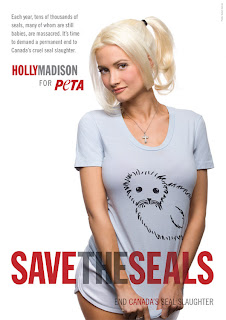
There are a variety of animal right's groups but PETA is the most famous, or rather, infamous. Emily brought up, in her blog, how PETA uses offensive advertisements to advocate animal rights but what they show also portrays false information and is always over the top. In Emily's example, PETA's add shows a half naked woman ready for the TSA scan (the full-body can in order to fly an airplane) whose underwear reads "Be proud of your body scan: Go Vegan." This ad is not only exploitative of the woman in the ad but it assumes the vegan diet always makes a person healthier, thin, and sexy. It also implies people do not want to go through the scan because they are ashamed of their bodies (and not because it is an invasion of privacy, Emily pointed out). PETA tends to play off of a serious problem to get the public's attention but the result is a public who does not take animal rights more seriously because they are revolted by the ways PETA protests and speaks up. Emily asked, "Why is PETA the most well-known animal rights group if their methods of effecting change are so problematic?"
PETA is the most well-known animal rights group because they try anything to be noticed. They like to get a rise out of people if it means maybe someone will look past the offensiveness and actually think about animal rights. They like to shock the public but it only gives PETA a bad reputation. In my blog, I have referred to PETA a couple of times because they do have good statistics and information on their site. However, this does not mean I support how they portray women. When I was googling PETA images to put in this blog, there were so many of naked women shown in cages, tied up, put on display as pieces of meat, shown as bloodied body parts, and so on. I understand PETA wants to give off some sort of message... but I have no idea what that message is because I can't get past the fact that these women are being so degraded. PETA could really make a difference for the lives of animals but I don't think their current methods are really helping animals out.
My question to you is: What should PETA do (or not do) in order to grow in popularity, actually get support from the public, and save the lives of animals at the same time?
The least offensive PETA advertisement I could find... and she isn't even wearing pants.

The Effects of Overpopulation.
The world's population is on its way to seven billion. Not only are their harsh effects for the standards of living for humans but animal habitats are being destroyed. Human activities such as mining, transportation, pollution, agriculture, development, and logging are all taking away habitat from wild animals as well as killing animals directly. These activities also contribute to climate change which threatens even the most remote wild life habitats on this planet as well as our own survival. More than 80% of the world’s old growth forests have been destroyed, wetlands are being drained for real estate development, and demands for biofuels take arable land away from crop production. Life on earth is currently experiencing its sixth extinction, and it has been estimated that we are losing approximately 30,000 species every year. The most famous major extinction was the fifth one, which occurred about 65 million years ago and wiped out the dinosaurs. The major extinction that we are now facing is the first that is caused not by an asteroid collision or other natural causes but by a single species: human beings.
My question to you is: Is it possible for human beings to slow down overpopulation and protect wildlife? What needs to be done?
Something to think about:
My question to you is: Is it possible for human beings to slow down overpopulation and protect wildlife? What needs to be done?
Something to think about:
Response to "Dogs and Cats."
Response #20
For as long as I can remember, there has been a 'war' between dogs and cats. As children and even into adulthood, we see movies and television shows where the cats are seen as evil and dogs as the good guys and they always despise each other. I do think it is interesting how cats and dogs are so different even though they sometimes live in the same households. It's also interesting how some people are clearly dog lovers and others prefer the independence of cats. This makes me wonder if it's because our personalities match the ways of one species more than the other or if there are other undiscovered reasons for choosing one domesticated animal over another. In Courtney's blog, she talked about how dogs have been domesticated much longer than cats: 15,000 years compared to 9,500 years. She compares common characteristics of dogs and cats saying dogs are more dependent while cats are independent animals. Cats are able to survive in the wild while dogs do not last as long. She then said it may be because dogs have been domesticated longer but that has not really been a proven answer. She asked, "What makes dogs so different from cats that they need to depend on us, while cats do not?"
For starters, even though they are both domesticated animals, they are different species of animals. Even treating them the same would give the owner two completely different animals and they are verrry different. For instance, dogs come when you call them while cats take their time and do so only if they want to. Dogs provide unconditional love while cats make you work for it and seem to hold grudges. Dogs let owners bathe and brush them but cats will put up a fight. Dogs bark to be heard but cats like to hide and be discrete. The list goes on. There are good reasons why cats and dogs have such distinctive personalities and behaviors which makes dogs dependent and cats the total opposite. The largest reason I see is that they have different social patterns and ways of interacting. Dogs are from packs and the members of their packs or families are critical to them. They see their owners as their packs and look for a leader. Some dogs strive for the leadership role but of course the owner does not let that happen. Carts are not pack animals and don't look for a human leader to follow. However, they aren't solitary animals as some may think. The relationships they form are more based on behavior, treatment, and territorial and survival concerns. If a cat is being treated badly, it won't stick around. However, if a dog is being abused, it will stay with the owner if there was once a connection between them because the owner is still the leader. In the wild, cats do form groups but this is influenced by whether there is enough food to hunt and if they are accepting of other cats around. Cats hunt independently; even pet cats hunt when they already have a supply of food. The ways cats and dogs interact with people and animals are fundamentally different.
Another difference is their physical make up. Cats, being solitary hunters, are physically unique. From the smallest house cat to their wild big cat cousins, they are physically suited as exceptional hunters. They have a good sense of smell and excellent hearing. They do not need humans to supply everything for them and if they do, cats hunt anyways because it is in their nature to be independent. They are flexible, excellent runners and jumpers, with other capabilities that are unmatched by other animals, even dogs. Dogs are best suited for finding prey and they have unbelievable tracking skills. This can be seen in many working dogs that use their tracking abilities for search and rescue, or to detect particular substances such as illegal drugs or explosives. This shows both a remarkable nose and an ability to be trained, along with a desire to please. Typically dogs have exceptional hearing too. Dogs have also been bred by people to have particular traits. Therefore some breeds are particularly good at picking up a scent, others are suited to hunt and retrieve, others are particularly fast runners, and unfortunately some dogs have been bred to fight making them much more aggressive than the average dog. Many dogs are bred mainly to be pets which usually leads to a good even tempered dog. While cats are bred too, it isn’t to the same extent as dogs and cats aren’t typically bred for a particular ability like dogs are, consequently it hasn’t affected the species the same way as dogs. There can be quite a range in personality and demeanor for both cats and dogs, but each has basics elements that are unique to their own species.
My question to you is: Are you a cat person or a dog lover and what makes you particular to one species over the other?

For as long as I can remember, there has been a 'war' between dogs and cats. As children and even into adulthood, we see movies and television shows where the cats are seen as evil and dogs as the good guys and they always despise each other. I do think it is interesting how cats and dogs are so different even though they sometimes live in the same households. It's also interesting how some people are clearly dog lovers and others prefer the independence of cats. This makes me wonder if it's because our personalities match the ways of one species more than the other or if there are other undiscovered reasons for choosing one domesticated animal over another. In Courtney's blog, she talked about how dogs have been domesticated much longer than cats: 15,000 years compared to 9,500 years. She compares common characteristics of dogs and cats saying dogs are more dependent while cats are independent animals. Cats are able to survive in the wild while dogs do not last as long. She then said it may be because dogs have been domesticated longer but that has not really been a proven answer. She asked, "What makes dogs so different from cats that they need to depend on us, while cats do not?"
For starters, even though they are both domesticated animals, they are different species of animals. Even treating them the same would give the owner two completely different animals and they are verrry different. For instance, dogs come when you call them while cats take their time and do so only if they want to. Dogs provide unconditional love while cats make you work for it and seem to hold grudges. Dogs let owners bathe and brush them but cats will put up a fight. Dogs bark to be heard but cats like to hide and be discrete. The list goes on. There are good reasons why cats and dogs have such distinctive personalities and behaviors which makes dogs dependent and cats the total opposite. The largest reason I see is that they have different social patterns and ways of interacting. Dogs are from packs and the members of their packs or families are critical to them. They see their owners as their packs and look for a leader. Some dogs strive for the leadership role but of course the owner does not let that happen. Carts are not pack animals and don't look for a human leader to follow. However, they aren't solitary animals as some may think. The relationships they form are more based on behavior, treatment, and territorial and survival concerns. If a cat is being treated badly, it won't stick around. However, if a dog is being abused, it will stay with the owner if there was once a connection between them because the owner is still the leader. In the wild, cats do form groups but this is influenced by whether there is enough food to hunt and if they are accepting of other cats around. Cats hunt independently; even pet cats hunt when they already have a supply of food. The ways cats and dogs interact with people and animals are fundamentally different.
Another difference is their physical make up. Cats, being solitary hunters, are physically unique. From the smallest house cat to their wild big cat cousins, they are physically suited as exceptional hunters. They have a good sense of smell and excellent hearing. They do not need humans to supply everything for them and if they do, cats hunt anyways because it is in their nature to be independent. They are flexible, excellent runners and jumpers, with other capabilities that are unmatched by other animals, even dogs. Dogs are best suited for finding prey and they have unbelievable tracking skills. This can be seen in many working dogs that use their tracking abilities for search and rescue, or to detect particular substances such as illegal drugs or explosives. This shows both a remarkable nose and an ability to be trained, along with a desire to please. Typically dogs have exceptional hearing too. Dogs have also been bred by people to have particular traits. Therefore some breeds are particularly good at picking up a scent, others are suited to hunt and retrieve, others are particularly fast runners, and unfortunately some dogs have been bred to fight making them much more aggressive than the average dog. Many dogs are bred mainly to be pets which usually leads to a good even tempered dog. While cats are bred too, it isn’t to the same extent as dogs and cats aren’t typically bred for a particular ability like dogs are, consequently it hasn’t affected the species the same way as dogs. There can be quite a range in personality and demeanor for both cats and dogs, but each has basics elements that are unique to their own species.
My question to you is: Are you a cat person or a dog lover and what makes you particular to one species over the other?

Wednesday, November 24, 2010
"Turkey Day."
There are over 300 million turkeys killed each year, in the US, and 65 million of them are killed for the Thanksgiving Holiday, according to GentleThanksgiving.com. As I was visiting sites that stressed the importance of going meat free this Thanksgiving, there were endless comments about how pointless it is and how people should enjoy their food, the meat on their plates. Some comments would say they support PETA (People for Eating Tasty Animals) and how trying to change tradition will not get any followers. This got me thinking, why are people so set in their ways? What's so good about a dried out 20 pound turkey, anyways? I personally look forward to the sweet potatoes and apple pie. If the word 'tofurky' is even mentioned, people shutter like its a disease. You can't even look up 'Thanksgiving' on the internet without getting a picture of a cooked turkey. Benjamin Franklin even wanted the turkey to be our national bird but the eagle won that competition. There are countless vegan holiday recipes which could satisfy everyone but people still insist on going out and buying a turkey. Do you think this 'tradition' will ever end?
My question to you is: What's so bad about tofurcky? What's it going to take for Americans to realize Thanksgiving is not about the 20 pound bird in the middle of the table but more about bringing family together? It's still Thanksgiving even if there isn't a turkey.
My question to you is: What's so bad about tofurcky? What's it going to take for Americans to realize Thanksgiving is not about the 20 pound bird in the middle of the table but more about bringing family together? It's still Thanksgiving even if there isn't a turkey.
Response to Becky and Freedom.
Response #19
In Becky's blog, she talked about how humans use animals in many ways but most are not necessary. For example, animals are used in medicine, as pets, transportation, clothing, zoos, farm hands, and food. She responded to Todd's question of whether or not animals can have freedom and liberty by defining freedom as, "the absence of necessity, coercion, or constraint in choice of action," and liberty as, "the power to do as one pleases." According to these Mariam-Webster dictionary answers, liberty and freedom go hand in hand. Animals used for clothing and food have no freedoms because they die for humans. Becky stated, in medical testing facilities, animals have a bit more freedom in their cages but they are still very restricted to do what they want, eat what they want, etc. They do not have the freedom to change their own living situations or say what they want/need. They suffer the most. Pets, Becky said, have even less freedom than cows and other farm animals depending on the owner. However, I think pets have the most freedom because they have the right to live and, in some homes, well. Farm animals, like cows and chickens, are killed mercilessly for our consumption. Many farm animals are treated much worse than pets because some families see their pets as part of the family, or as valuable property, but farm animals are simply a means of production. Zoo animals also have such little freedom because they are put on display their whole lives. Becky then asked, "Are humans even free? Who has more freedom: wild animals or humans?"
This is a very debatable question. The bottom line is, I do not think there is such thing as total freedom. People and animals have freedoms but they are still restricted in all that they do. In some places, humans have much more freedom than wild animals because humans are able to wipe out whole species, like the buffalo, just for their 'needs' and without a second thought. However, wild animals do not have to pay taxes, follow laws, or purchase anything for that matter. They aren't limited to certain spaces, in some countries, and are not trapped by the greed of other people. Wild animals can kill without consequences, they can live where they please, they have few worries, especially animals higher up on the ladder who have very few predators. However, animals still need to worry about feeding their young and other dangers/predators but if there is a steady supply of food and good shelter, then they are fine.
Humans have fought for freedom since the beginning and are still fighting today, especially for women and minority races. Everything boils down to money and if you don't have it, you can't do a thing. You don't have food or shelter; you don't have anything. Our society, however, does not leave the wild animals alone. I think humans want to limit the freedom of animals just like their freedoms are limited. If a person breaks the law, he or she gets locked up. However, animals do not have to do anything wrong in order to be locked up. Humans are driven by their superiority and do not like to let wild animals stay free. Humans lock them up, poke them with needles, examine them, try to put them on display, and restrict where they can go by creating industrialized worlds and ruining habitation. Although humans don't actually have freedom, wild animals are losing theirs as the world advances. I think no one is really free. No matter where a person goes or what a person does, he or she has laws and people that restrict him or her to the fullest. At first, I would say wild animals are more free but I think they are losing their freedom every day just as humans are.
My question to you is: Do you think wild animals and humans can both be free simultaneously and what needs to happen for both species to be granted more freedoms in such a restrictive, controlling world?

In Becky's blog, she talked about how humans use animals in many ways but most are not necessary. For example, animals are used in medicine, as pets, transportation, clothing, zoos, farm hands, and food. She responded to Todd's question of whether or not animals can have freedom and liberty by defining freedom as, "the absence of necessity, coercion, or constraint in choice of action," and liberty as, "the power to do as one pleases." According to these Mariam-Webster dictionary answers, liberty and freedom go hand in hand. Animals used for clothing and food have no freedoms because they die for humans. Becky stated, in medical testing facilities, animals have a bit more freedom in their cages but they are still very restricted to do what they want, eat what they want, etc. They do not have the freedom to change their own living situations or say what they want/need. They suffer the most. Pets, Becky said, have even less freedom than cows and other farm animals depending on the owner. However, I think pets have the most freedom because they have the right to live and, in some homes, well. Farm animals, like cows and chickens, are killed mercilessly for our consumption. Many farm animals are treated much worse than pets because some families see their pets as part of the family, or as valuable property, but farm animals are simply a means of production. Zoo animals also have such little freedom because they are put on display their whole lives. Becky then asked, "Are humans even free? Who has more freedom: wild animals or humans?"
This is a very debatable question. The bottom line is, I do not think there is such thing as total freedom. People and animals have freedoms but they are still restricted in all that they do. In some places, humans have much more freedom than wild animals because humans are able to wipe out whole species, like the buffalo, just for their 'needs' and without a second thought. However, wild animals do not have to pay taxes, follow laws, or purchase anything for that matter. They aren't limited to certain spaces, in some countries, and are not trapped by the greed of other people. Wild animals can kill without consequences, they can live where they please, they have few worries, especially animals higher up on the ladder who have very few predators. However, animals still need to worry about feeding their young and other dangers/predators but if there is a steady supply of food and good shelter, then they are fine.
Humans have fought for freedom since the beginning and are still fighting today, especially for women and minority races. Everything boils down to money and if you don't have it, you can't do a thing. You don't have food or shelter; you don't have anything. Our society, however, does not leave the wild animals alone. I think humans want to limit the freedom of animals just like their freedoms are limited. If a person breaks the law, he or she gets locked up. However, animals do not have to do anything wrong in order to be locked up. Humans are driven by their superiority and do not like to let wild animals stay free. Humans lock them up, poke them with needles, examine them, try to put them on display, and restrict where they can go by creating industrialized worlds and ruining habitation. Although humans don't actually have freedom, wild animals are losing theirs as the world advances. I think no one is really free. No matter where a person goes or what a person does, he or she has laws and people that restrict him or her to the fullest. At first, I would say wild animals are more free but I think they are losing their freedom every day just as humans are.
My question to you is: Do you think wild animals and humans can both be free simultaneously and what needs to happen for both species to be granted more freedoms in such a restrictive, controlling world?

Thursday, November 18, 2010
Response to Hallie and Jenna on "Leashes."
Response #18
In Hallie's blog, she talks about how, before this class, she never really looked at leashes as disturbing or as a way for humans to yet again be superior and in control. She decided there is really no reason to use them since it restricts the animal's freedom and it is obvious the dog knows a leash is being used on him or her. It is hard to argue that dogs are persons when they are on leashes; when they are being pulled one way or another and being restricted to where they can go. This brings up the idea of children on leashes and how disturbing it is to see this taking place. Hallie then brought up the point that we are not as shocked or disturbed to see dogs on leashes as we are children even though dogs are placed somewhere between friend and child. People who leash dogs are trying to control them while people who leash children want to protect them. Jenna then responds to this by saying it is the law to have a dog on a leash but it isn't required for children to be. She points out that having leashes on dogs is hard to get around because it is required but no one deserves to be locked in or controlled in such a way.
Jenna then asked, "Why do we look at child leashes negatively? It is better than seeing a parent who lets their child run way ahead of them while talking to another adult, to me that is abuse. Children need boundaries to keep them safe, at all ages. What do you think?" I think we look at child leashes negatively because it's just so odd to see. It's rare so when we do see it, we are shocked and pin the mother or father as controlling, overprotective, and a bit cruel. Personally, I would never want to be put on a leash, even when I was a child. Seeing parents hold the hand of their children instead of keeping them on leashes is a much more caring gesture. It shows the parents are protecting the child but letting him or her walk on his or her own. When I picture a dog or child on a leash, I see the person holding the leash tugging on it and controlling where the dog or child goes. I understand it is a way to protect a child or animal but it is degrading, in my opinion, even for young children. It's a sign of superiority. Also, when a person calls another person a dog, this is an insult. So when we see children with leashes, we may see this as insulting as well. Even though many people see dogs as family or as persons, it seems as though calling someone a dog is not a nice name. So, we see putting leashes on children as negative.
I would be perfectly content holding the hand of my child or carrying him or her. I don't see the reason for having a leash on a child. To me, it's unnatural and kind of cruel. To the public, it is like treating a child as a dog and a lot of pet owners don't treat their dogs like persons. I understand the reason for leashes on dogs because they can be more dangerous than children. They are more unpredictable and quick. I would encourage not using a leash on a dog whenever a pet owner can but I do understand it is a law that should be followed or else poorly trained and aggressive dogs could really hurt someone or be hurt. I use a leash on my dog to protect him but I think there are other ways to protect children than to leash them.
My question to you is: Would you ever leash your child and do you leash your dog? Why is this? What are the differences between leashing a child and leashing a dog?

In Hallie's blog, she talks about how, before this class, she never really looked at leashes as disturbing or as a way for humans to yet again be superior and in control. She decided there is really no reason to use them since it restricts the animal's freedom and it is obvious the dog knows a leash is being used on him or her. It is hard to argue that dogs are persons when they are on leashes; when they are being pulled one way or another and being restricted to where they can go. This brings up the idea of children on leashes and how disturbing it is to see this taking place. Hallie then brought up the point that we are not as shocked or disturbed to see dogs on leashes as we are children even though dogs are placed somewhere between friend and child. People who leash dogs are trying to control them while people who leash children want to protect them. Jenna then responds to this by saying it is the law to have a dog on a leash but it isn't required for children to be. She points out that having leashes on dogs is hard to get around because it is required but no one deserves to be locked in or controlled in such a way.
Jenna then asked, "Why do we look at child leashes negatively? It is better than seeing a parent who lets their child run way ahead of them while talking to another adult, to me that is abuse. Children need boundaries to keep them safe, at all ages. What do you think?" I think we look at child leashes negatively because it's just so odd to see. It's rare so when we do see it, we are shocked and pin the mother or father as controlling, overprotective, and a bit cruel. Personally, I would never want to be put on a leash, even when I was a child. Seeing parents hold the hand of their children instead of keeping them on leashes is a much more caring gesture. It shows the parents are protecting the child but letting him or her walk on his or her own. When I picture a dog or child on a leash, I see the person holding the leash tugging on it and controlling where the dog or child goes. I understand it is a way to protect a child or animal but it is degrading, in my opinion, even for young children. It's a sign of superiority. Also, when a person calls another person a dog, this is an insult. So when we see children with leashes, we may see this as insulting as well. Even though many people see dogs as family or as persons, it seems as though calling someone a dog is not a nice name. So, we see putting leashes on children as negative.
I would be perfectly content holding the hand of my child or carrying him or her. I don't see the reason for having a leash on a child. To me, it's unnatural and kind of cruel. To the public, it is like treating a child as a dog and a lot of pet owners don't treat their dogs like persons. I understand the reason for leashes on dogs because they can be more dangerous than children. They are more unpredictable and quick. I would encourage not using a leash on a dog whenever a pet owner can but I do understand it is a law that should be followed or else poorly trained and aggressive dogs could really hurt someone or be hurt. I use a leash on my dog to protect him but I think there are other ways to protect children than to leash them.
My question to you is: Would you ever leash your child and do you leash your dog? Why is this? What are the differences between leashing a child and leashing a dog?

Declawing Cats = Mutilation.
Before I get started, I will simply lay it on the table for you. I am completely against the declawing of cats or any other animal for that matter. I do not see anything right about mutilating an animal for the sake of living room furniture. I have been wanting to mention this in class but I never found the right moment. So, here is my stance.
According to declawing.com, only Americans have adopted the idea of declawing a cat and it has only been for the convenience and benefit of the pet owner. In many European countries, such an act is deemed inhumane and is illegal. What many people do not seem to realize is that declawing a cat is a serious surgery. The claw is not like a nail; it is closely attached to the cat's bone. To remove the claw, the last bone of the cat's claw has to be removed. Declawing is actually an amputation of the last joint of the cat's 'toe' and it is a very painful procedure with a long recovery period. During that period, the animal still needs to use its swollen feet to walk, jump, and scratch its litter box. Cats don't get wheelchairs. Pet owners often do not see their cat is in pain because, unlike human beings, they are very independent and do not want to show weakness. It is in their nature to be prideful, and their instincts tell them to hide the situation because they do not want to lose their superiority from other animals. A cat's body is designed to give it agility and grace that is unique to felines. Its claws are an important part of this design. They need them to climb trees when predators are near, to protect and defend themselves, and to scratch cat littler. When they claw furniture, they are just trying to sharpen their claws. It also exercise their claw muscles, scrapes off the old outside covering, and releases their scent. Amputating the claw alters the conformation of their feet and is depriving the cat of its primary means of defense, leaving it prey to predators if it ever escapes to the outdoors.
When I worked at the veterinary clinic (I know I bring this up a lot but it has shaped a lot of my views), the vet would only declaw the front paws. Cats would have to come in a day in advance for surgery to make sure there is no food in its body. Once the surgery is done, the cats two front legs and paws are completely wrapped up in bandages making it hard for the animal to stand. It takes a long time for them to come-to and when they do, they are given paper for cat litter. If they have normal cat litter and the litter gets into their casts, this could cause major irritation and infection. When I saw cats wake up and see what has happened to their legs, they try to remove the cats, they meow, and they knock over all of their food and liter. Pet owners have also reported a change in the cat's personality after declawing happens. However, pet owners who keep their cats indoors at all times, still go through with the procedure. But think about this: What if the cat runs away? What if it happens to go outside and needs its claws to defend itself? What if the pet owner abandons the declawed cat? How will it survive? Cats can learn. If they are given an alternative to furniture, like a scratch post, they learn to use it. There are also 'soft paws' which are plastic caps a pet owner can put on his or her cat. Personally, I just stick with the scratch post but caps are better than amputation/mutilation methods.
My question to you is: Are there any ways in which the declawing of cats can be defended? Along these lines, what is your take on amputating the tails of dogs?

According to declawing.com, only Americans have adopted the idea of declawing a cat and it has only been for the convenience and benefit of the pet owner. In many European countries, such an act is deemed inhumane and is illegal. What many people do not seem to realize is that declawing a cat is a serious surgery. The claw is not like a nail; it is closely attached to the cat's bone. To remove the claw, the last bone of the cat's claw has to be removed. Declawing is actually an amputation of the last joint of the cat's 'toe' and it is a very painful procedure with a long recovery period. During that period, the animal still needs to use its swollen feet to walk, jump, and scratch its litter box. Cats don't get wheelchairs. Pet owners often do not see their cat is in pain because, unlike human beings, they are very independent and do not want to show weakness. It is in their nature to be prideful, and their instincts tell them to hide the situation because they do not want to lose their superiority from other animals. A cat's body is designed to give it agility and grace that is unique to felines. Its claws are an important part of this design. They need them to climb trees when predators are near, to protect and defend themselves, and to scratch cat littler. When they claw furniture, they are just trying to sharpen their claws. It also exercise their claw muscles, scrapes off the old outside covering, and releases their scent. Amputating the claw alters the conformation of their feet and is depriving the cat of its primary means of defense, leaving it prey to predators if it ever escapes to the outdoors.
When I worked at the veterinary clinic (I know I bring this up a lot but it has shaped a lot of my views), the vet would only declaw the front paws. Cats would have to come in a day in advance for surgery to make sure there is no food in its body. Once the surgery is done, the cats two front legs and paws are completely wrapped up in bandages making it hard for the animal to stand. It takes a long time for them to come-to and when they do, they are given paper for cat litter. If they have normal cat litter and the litter gets into their casts, this could cause major irritation and infection. When I saw cats wake up and see what has happened to their legs, they try to remove the cats, they meow, and they knock over all of their food and liter. Pet owners have also reported a change in the cat's personality after declawing happens. However, pet owners who keep their cats indoors at all times, still go through with the procedure. But think about this: What if the cat runs away? What if it happens to go outside and needs its claws to defend itself? What if the pet owner abandons the declawed cat? How will it survive? Cats can learn. If they are given an alternative to furniture, like a scratch post, they learn to use it. There are also 'soft paws' which are plastic caps a pet owner can put on his or her cat. Personally, I just stick with the scratch post but caps are better than amputation/mutilation methods.
My question to you is: Are there any ways in which the declawing of cats can be defended? Along these lines, what is your take on amputating the tails of dogs?

Response to Kim and "Home Visits."
Response #17
In Kim's blog, she talks about pet ownership and how people should be required to follow certain rules and regulations not just when they adopt an animal but also when they buy their pets. Although no one can tell a person how to raise his or her pet, it should be necessary, for the safety and well being of the animal, to set guidelines and rules for the owner to follow no matter how they obtained the animal. Kim suggests all dogs should be required to of through some form of socialization like a school for dogs, specified dog parks, or training classes. Dogs should know basic commands like sit, stay, drop it, and lie town in order to keep them save and others as well. Dogs are social beings and enjoy interaction with other animals. This way, they will not be as aggressive. Dogs and other pets also need to be registered in case of animal abuse situations. It's important to be aware of which households own pets so, if need be, professionals can step in if the dog or other pet is being abused. Also, Kim said dogs and cats should have identification microchips in case they get lost so they can be returned to their owners. Lastly, she brings up the idea of home visits where people go into a home where there are pets and make sure they have adequate food, shelter, care, and a place to get exercise. She then asked, "Do you feel that home visits should be allowed, encouraged, banned or discouraged and why?"
I also think it is peculiar that organizations where animals are adopted require home visits but when people attain pets from stores or through another means, home visits aren't even thought about. Some people see home visits as an invasion of privacy and unnecessary. However, according to PETA, there were 1,880 cruelty cases last year and the majority of those were against dogs. If going into a person's home once a year or every six months, just to make sure the dog is in good hands, could potentially save a life, then it is worth it. When I worked at the veterinary clinic in my hometown for two years, I saw abused animals but, as employees, we did not have the right to say anything since we did not know the actual situation. People abuse their pets without even knowing it by over or underfeeding, by keeping them in cages all day while they are at work, by not letting their dogs out enough times during their day, or by smacking their animals as a way to discipline them. I encourage home visits; I think they should be mandatory and I think every pet should be licensed. Animal cruelty is serious but often overlooked. Any effort to decrease the number of abused animals in the world is something I'll stand behind.
My question to you is: Do you think home visits and other regulations/guide lines should apply only to dog owners or should they be required for all sorts of other pets like cats, rabbits, hamsters, and even fish?

In Kim's blog, she talks about pet ownership and how people should be required to follow certain rules and regulations not just when they adopt an animal but also when they buy their pets. Although no one can tell a person how to raise his or her pet, it should be necessary, for the safety and well being of the animal, to set guidelines and rules for the owner to follow no matter how they obtained the animal. Kim suggests all dogs should be required to of through some form of socialization like a school for dogs, specified dog parks, or training classes. Dogs should know basic commands like sit, stay, drop it, and lie town in order to keep them save and others as well. Dogs are social beings and enjoy interaction with other animals. This way, they will not be as aggressive. Dogs and other pets also need to be registered in case of animal abuse situations. It's important to be aware of which households own pets so, if need be, professionals can step in if the dog or other pet is being abused. Also, Kim said dogs and cats should have identification microchips in case they get lost so they can be returned to their owners. Lastly, she brings up the idea of home visits where people go into a home where there are pets and make sure they have adequate food, shelter, care, and a place to get exercise. She then asked, "Do you feel that home visits should be allowed, encouraged, banned or discouraged and why?"
I also think it is peculiar that organizations where animals are adopted require home visits but when people attain pets from stores or through another means, home visits aren't even thought about. Some people see home visits as an invasion of privacy and unnecessary. However, according to PETA, there were 1,880 cruelty cases last year and the majority of those were against dogs. If going into a person's home once a year or every six months, just to make sure the dog is in good hands, could potentially save a life, then it is worth it. When I worked at the veterinary clinic in my hometown for two years, I saw abused animals but, as employees, we did not have the right to say anything since we did not know the actual situation. People abuse their pets without even knowing it by over or underfeeding, by keeping them in cages all day while they are at work, by not letting their dogs out enough times during their day, or by smacking their animals as a way to discipline them. I encourage home visits; I think they should be mandatory and I think every pet should be licensed. Animal cruelty is serious but often overlooked. Any effort to decrease the number of abused animals in the world is something I'll stand behind.
My question to you is: Do you think home visits and other regulations/guide lines should apply only to dog owners or should they be required for all sorts of other pets like cats, rabbits, hamsters, and even fish?

Wednesday, November 10, 2010
Response to "People Who Look Like Their Dogs."
Response #16
In Becky's blog, she talks about the theory of developmental attraction and the reward-theory of attraction. She brought up the point that humans are attracted to the things that reward us most. She used the example of how people who have the same views stick together because it is comforting and rewarding to know someone is on the same level as you. This also effects dog ownership because people choose animals that relate to them most. Becky said it is a proven fact that people choose dogs they tend to look like. There are over a hundred different dog breeds and people choose their pets based on a number of reasons; how they look, how active they are, how big or small, how long their lifespan is, if they do well with children, and so on. Becky asks, "If you own a dog, what made you choose that breed? Also, do you think you look like your dog?"
I worked at a veterinary clinic for two years so I saw a lot of different breeds of dogs. I found that most owners seemed to resemble their pets and the ones that resembled them the most had the greatest amount of love and respect towards their animal. My family owns a Pomeranian (not my choice). I look nothing like a Pomeranian (thank you very much) but he technically isn't my dog. If I were to choose a dog breed, I would own a Siberian Husky because their active and playful, free-spirited, an d beautiful. I also have a soft spot for West Highland White Terriers. They are just too adorable. Working with all different kinds of dogs made me realize something; mixed breeds and shelter dogs are generally much better animals. Every purebred dog has a certain genetic problem but they tend to be valued more. The dogs rescued and brought to the vets were usually "mutts" but they were the kindest and most deserving animals. They just wanted a home. The purebreds I worked with were much more testy and mean but the mixed breed dogs were just the opposite. If I were recommending a new dog to a person, I would say it is best to go to a shelter and rescue a mixed-breed dog because they are the ones that seem to appreciate life much more than any sole breed does. But this is just my experience.
Another interesting idea I have thought about while daydreaming at the vets is how everyone truly does resemble a certain breed of dog. Based on how the dog looks and acts, every person in my life seems to have a dog counterpart. Something else I have learned is the stereotype pit-bulls and rottweilers have of being viscous animals is false. I knew the kindest rottweiler pair and a handful of other kind pit-bulls but I always thought they were scary animals. I think the way the media portrays these dogs is really negative. Any dog can be mean if his or her owner trains it that way or treats it poorly. Another topic about the treatment of animals is how people dress up their dogs to make them look like miniature humans. Pet stores have a huge variety of clothing for dogs but I wonder if this crosses a line of some sort. Animals aren't meant to be fashion statements. Do we dress up dogs to make them more human-like or to humiliate/torture them in the name of cuteness? I personally would never dress up a dog with human clothing but I want to know how you feel about the idea.
My question to you is: Is there a line being crossed when pet owners dress up their dogs to look like miniature humans? Is it wrong and unnatural to do this or is it just an innocent act, in your opinion? Why or why not?
Cute or just plain cruel?

In Becky's blog, she talks about the theory of developmental attraction and the reward-theory of attraction. She brought up the point that humans are attracted to the things that reward us most. She used the example of how people who have the same views stick together because it is comforting and rewarding to know someone is on the same level as you. This also effects dog ownership because people choose animals that relate to them most. Becky said it is a proven fact that people choose dogs they tend to look like. There are over a hundred different dog breeds and people choose their pets based on a number of reasons; how they look, how active they are, how big or small, how long their lifespan is, if they do well with children, and so on. Becky asks, "If you own a dog, what made you choose that breed? Also, do you think you look like your dog?"
I worked at a veterinary clinic for two years so I saw a lot of different breeds of dogs. I found that most owners seemed to resemble their pets and the ones that resembled them the most had the greatest amount of love and respect towards their animal. My family owns a Pomeranian (not my choice). I look nothing like a Pomeranian (thank you very much) but he technically isn't my dog. If I were to choose a dog breed, I would own a Siberian Husky because their active and playful, free-spirited, an d beautiful. I also have a soft spot for West Highland White Terriers. They are just too adorable. Working with all different kinds of dogs made me realize something; mixed breeds and shelter dogs are generally much better animals. Every purebred dog has a certain genetic problem but they tend to be valued more. The dogs rescued and brought to the vets were usually "mutts" but they were the kindest and most deserving animals. They just wanted a home. The purebreds I worked with were much more testy and mean but the mixed breed dogs were just the opposite. If I were recommending a new dog to a person, I would say it is best to go to a shelter and rescue a mixed-breed dog because they are the ones that seem to appreciate life much more than any sole breed does. But this is just my experience.
Another interesting idea I have thought about while daydreaming at the vets is how everyone truly does resemble a certain breed of dog. Based on how the dog looks and acts, every person in my life seems to have a dog counterpart. Something else I have learned is the stereotype pit-bulls and rottweilers have of being viscous animals is false. I knew the kindest rottweiler pair and a handful of other kind pit-bulls but I always thought they were scary animals. I think the way the media portrays these dogs is really negative. Any dog can be mean if his or her owner trains it that way or treats it poorly. Another topic about the treatment of animals is how people dress up their dogs to make them look like miniature humans. Pet stores have a huge variety of clothing for dogs but I wonder if this crosses a line of some sort. Animals aren't meant to be fashion statements. Do we dress up dogs to make them more human-like or to humiliate/torture them in the name of cuteness? I personally would never dress up a dog with human clothing but I want to know how you feel about the idea.
My question to you is: Is there a line being crossed when pet owners dress up their dogs to look like miniature humans? Is it wrong and unnatural to do this or is it just an innocent act, in your opinion? Why or why not?
Cute or just plain cruel?

Tuesday, November 9, 2010
Buying vs. Adopting
When a person goes to buy a dog, he or she has many options. That person can choose to rescue a dog from a shelter, buy a dog from a breeder, or buy the animal from a store. Clare Palmer, in chapter 77 of the reading, stated that 6 to 10 million dogs and 7 to 10 million cats were killed in pet shelters in the U.S. in 1990. Because of the massive amounts of breeding done in puppy mills and pet owners' failure to spay and neuter their pets has created an overpopulation of homeless and caged dogs and cats. If a person wants a certain breed of puppy and can't find it in a shelter even though twenty percent of animals in shelters are purebred, I see nothing wrong with going to a reputable breeder for the right dog. Because there are so many neglected animals in shelters, I encourage all pet owners to seek animals from these shelters before going to a breeder.
When I worked at the Veterinary Clinic in High School, there were a couple breeders in town who's dogs the Vet cared for. The puppies were treated well and given proper medical attention. If a person feels like spending hundreds of dollars on a certain breed then there is nothing wrong with going to a breeder of that dog. However, because of how unethical and cruel puppy mills are, I do not condone buying dogs from pet stores. Many people are oblivious as to what their puppy has gone through. It's important that a person knows who he or she is getting the dog from and what kind of life that dog previously lived.
No matter the animal, he or she does need a home, but buying him or her from a store supports the puppy mill business. Puppy mills are the same as factory farms for dogs. They are also called "commercial breeders" and their only purpose is to make a profit. Female dogs are bred over and over again and puppies are crammed into small cages all of the time. Although puppy mills are legal for licensed breeders, they allow the breeder to own several hundred or even a thousand dogs. All animals are kept in small cages and dogs are bred as much as possible in order to produce an enormous amount of puppies. The standards of puppy mills are set forth by the government but are not meant to ensure a good life for the dogs. They are set as bare minimum requirements for the animals. Puppy mill's breed about 4 million dogs a year. I know one person's choice to adopt instead of to buy a puppy will not make a difference and if everyone starts to do this, the puppies in the mills will be left without a home.
My question to you is: How can the problem of domestic animal overpopulation, ignorance of breeding, and the cruelty in puppy mills come to an end? Do you ever see this happening?

When I worked at the Veterinary Clinic in High School, there were a couple breeders in town who's dogs the Vet cared for. The puppies were treated well and given proper medical attention. If a person feels like spending hundreds of dollars on a certain breed then there is nothing wrong with going to a breeder of that dog. However, because of how unethical and cruel puppy mills are, I do not condone buying dogs from pet stores. Many people are oblivious as to what their puppy has gone through. It's important that a person knows who he or she is getting the dog from and what kind of life that dog previously lived.
No matter the animal, he or she does need a home, but buying him or her from a store supports the puppy mill business. Puppy mills are the same as factory farms for dogs. They are also called "commercial breeders" and their only purpose is to make a profit. Female dogs are bred over and over again and puppies are crammed into small cages all of the time. Although puppy mills are legal for licensed breeders, they allow the breeder to own several hundred or even a thousand dogs. All animals are kept in small cages and dogs are bred as much as possible in order to produce an enormous amount of puppies. The standards of puppy mills are set forth by the government but are not meant to ensure a good life for the dogs. They are set as bare minimum requirements for the animals. Puppy mill's breed about 4 million dogs a year. I know one person's choice to adopt instead of to buy a puppy will not make a difference and if everyone starts to do this, the puppies in the mills will be left without a home.
My question to you is: How can the problem of domestic animal overpopulation, ignorance of breeding, and the cruelty in puppy mills come to an end? Do you ever see this happening?

Response to "Wild Animals in Captivity."
Response #15
In Nicole's blog, she talks about her experience at a petting zoo and how she wondered in what ways the exotic animals reacted to their initial confinement. What was it like to be watched all day while everyone on the outside is looking in, Nicole asked. Farm animals and other domestic breeds are more likely to react positively to confinement since they already are. However, exotic wild animals get their complete freedom taken away from them. They are not meant to be behind bars. I'm not saying domestic animals are either but they react much better to losing the freedoms they once had since those freedoms were much smaller than the freedom wild animals are born into. Nicole talks about seeing baboons looking on desperately for a way out, owls and other birds not being able to fly, and wolves hiding in the corner while hundreds of people walked by. These animals seemed very bored and uncomfortable in their new unnatural habitat. Nicole says these animals are just not meant to be caged up. There is no way to find contentment for these locked up animals. Even though some would say these animals are safer locked up because predators can not get to them, in the wild, at least they would be able to act naturally and run or fly away if need be.
Then, Nicole relates this confinement with feminism, saying how women used to be seen as their husband's property a hundred years ago. Women were seen as passive things who "needed" protection and care. However, this would not fly nowadays, Nicole points out. Women fought this stereotypical idea of the passive female and refused to be locked up in the home when they could be making their own living. With freedom comes responsibility, but I can all humans and animals have a right to fend and protect themselves in all situations. Finally, Nicole asks, "Do you think filming animals in the wild is a breach of their privacy or is that just a human concept which non-humans do not care about?"
I think filming animals is better than keeping them locked up in zoos. It is impossible to really know what a non-human animal is thinking so invading their privacy may or may not be noticed by them, we really can't know. To me, zoos are like prisons. When people break the law, they get locked up. The worse the illegal act they performed, the more years they get sentenced. However, animals never do anything to deserve such treatment. When we go to zoos, people do not think the animals must have done something terrible to be locked away because they haven't. We don't really question the ethics of zoos; we just wonder through like the rest of the tourists. I think, because our society is so technologically advanced, it would be a great idea to create these zoo animals and make them as natural and real as we possibly can so no one can tell the difference. Of course, people would know because word would get out but at least they would be able to see these animals without really confining them. Another alternative is having people go through safari like replications or reserves where wild animals roam free. Or, placing cameras in the wild where animals may be could give humans an idea of how animals really act in the wild. I am not opposed to cameras in the wild as long as this stops zoos from confining animals. Filming anyone against their knowing is a breach to privacy but it is a much better alternative to zoos because no harm is done to the animals. There would need to be people in charge of monitoring and maintaining these cameras but it really could work, in my opinion.
My questions are: Why are people generally oblivious to the cruelty of confining animals in zoos and cages (like I was as a child and even before this class)? Do you think people are actually aware but choose to ignore when cruelty is taking place? Also, why don't people put themselves in the animals' situation more often? A lot would change.
Here is a picture I took at the zoo quite a few years back. Then, I didn't even take notice to how sad and desperate this animal looks. I was just excited about seeing animals I had only heard and read about. Now it's impossible to ignore how unhappy this animal is... like a prisoner.

In Nicole's blog, she talks about her experience at a petting zoo and how she wondered in what ways the exotic animals reacted to their initial confinement. What was it like to be watched all day while everyone on the outside is looking in, Nicole asked. Farm animals and other domestic breeds are more likely to react positively to confinement since they already are. However, exotic wild animals get their complete freedom taken away from them. They are not meant to be behind bars. I'm not saying domestic animals are either but they react much better to losing the freedoms they once had since those freedoms were much smaller than the freedom wild animals are born into. Nicole talks about seeing baboons looking on desperately for a way out, owls and other birds not being able to fly, and wolves hiding in the corner while hundreds of people walked by. These animals seemed very bored and uncomfortable in their new unnatural habitat. Nicole says these animals are just not meant to be caged up. There is no way to find contentment for these locked up animals. Even though some would say these animals are safer locked up because predators can not get to them, in the wild, at least they would be able to act naturally and run or fly away if need be.
Then, Nicole relates this confinement with feminism, saying how women used to be seen as their husband's property a hundred years ago. Women were seen as passive things who "needed" protection and care. However, this would not fly nowadays, Nicole points out. Women fought this stereotypical idea of the passive female and refused to be locked up in the home when they could be making their own living. With freedom comes responsibility, but I can all humans and animals have a right to fend and protect themselves in all situations. Finally, Nicole asks, "Do you think filming animals in the wild is a breach of their privacy or is that just a human concept which non-humans do not care about?"
I think filming animals is better than keeping them locked up in zoos. It is impossible to really know what a non-human animal is thinking so invading their privacy may or may not be noticed by them, we really can't know. To me, zoos are like prisons. When people break the law, they get locked up. The worse the illegal act they performed, the more years they get sentenced. However, animals never do anything to deserve such treatment. When we go to zoos, people do not think the animals must have done something terrible to be locked away because they haven't. We don't really question the ethics of zoos; we just wonder through like the rest of the tourists. I think, because our society is so technologically advanced, it would be a great idea to create these zoo animals and make them as natural and real as we possibly can so no one can tell the difference. Of course, people would know because word would get out but at least they would be able to see these animals without really confining them. Another alternative is having people go through safari like replications or reserves where wild animals roam free. Or, placing cameras in the wild where animals may be could give humans an idea of how animals really act in the wild. I am not opposed to cameras in the wild as long as this stops zoos from confining animals. Filming anyone against their knowing is a breach to privacy but it is a much better alternative to zoos because no harm is done to the animals. There would need to be people in charge of monitoring and maintaining these cameras but it really could work, in my opinion.
My questions are: Why are people generally oblivious to the cruelty of confining animals in zoos and cages (like I was as a child and even before this class)? Do you think people are actually aware but choose to ignore when cruelty is taking place? Also, why don't people put themselves in the animals' situation more often? A lot would change.
Here is a picture I took at the zoo quite a few years back. Then, I didn't even take notice to how sad and desperate this animal looks. I was just excited about seeing animals I had only heard and read about. Now it's impossible to ignore how unhappy this animal is... like a prisoner.

Thursday, November 4, 2010
Animals as Clothing.
Every year, millions of animals are killed for the clothing for their fur, wool, silk, and leather. "Whether they come from Chinese fur farms, Indian slaughterhouses, or the Australian outback, an immeasurable amount of suffering goes into every fur-trimmed jacket, leather belt, and wool sweater," according to PETA. Animals, like in slaughterhouses, are confined for their whole lives in small, dirty cages and the industry uses the cheapest method of killing these animals possible. More than half of the fur in the U.S. comes from China, where millions of dogs and cats are even killed for their fur and often the fur is mislabeled so people don't know what species of animal they are wearing. Leather is not just a byproduct of slaughterhouses but it is a growing industry. The meat industry relies on skin sales to keep business on the rise. It even accounts for 50% of the total byproduct of cattle. All animals who end up as belts or shoes suffer confinement, branding, unanesthetized castration, tail-docking, dehorning, and cruel treatment during transportation and slaughter.
People, and the fur industry, would like to see fur as just another fabric but it's actually the skin ripped and peeled off the backs of animals. In our culture and society, there is no reason to use animals for clothing. In other cultures where animals are hunted for food and used as clothing for survival is justifiable since they do not have alternatives. However, in industrialized countries, there is no reason for it. More often than not, people don't even realize they are wearing animal products; I know I have shoes with leather in them. I think it is important for everyone to be more aware of their purchases and how what they buy affects animals. If we choose to buy products that were made without harming animals, then companies would find alternatives. The first step is being aware of what we wear. Then follows change.
My question to you is: There are many alternatives (like synthetic materials) to using animals for leather, wool, fur, silk, etc. So, why does our culture still exploit animals for clothing aside from it being a lucrative business?
A leather jacket and a wool sweater? Really?
People, and the fur industry, would like to see fur as just another fabric but it's actually the skin ripped and peeled off the backs of animals. In our culture and society, there is no reason to use animals for clothing. In other cultures where animals are hunted for food and used as clothing for survival is justifiable since they do not have alternatives. However, in industrialized countries, there is no reason for it. More often than not, people don't even realize they are wearing animal products; I know I have shoes with leather in them. I think it is important for everyone to be more aware of their purchases and how what they buy affects animals. If we choose to buy products that were made without harming animals, then companies would find alternatives. The first step is being aware of what we wear. Then follows change.
My question to you is: There are many alternatives (like synthetic materials) to using animals for leather, wool, fur, silk, etc. So, why does our culture still exploit animals for clothing aside from it being a lucrative business?
A leather jacket and a wool sweater? Really?
Humane Meat: An Oxymoron?
Sometimes, when I tell people I am opposed to the way the meat industry slaughters animals for food, they reply with the idea of choosing free range animals for consumption since they get to experience life and the outdoors. As the truth of how factory farms treat their animals surfaces to the public, more people are choosing organic foods and free range meat. Slaughterhouses kill animals while they are still conscious with the production line moving so fast no one knows what is actually being put in with the animal meat. Animals are confined to dark, small spaces and live their lives eating antibiotics and hormones so they grow twice as fast. Disease is not uncommon in such small spaces. A solution has been raised to stop supporting these big corporations and start buying free range meat which means the animals are free to graze the outdoors instead of being stuck in dark confinement. However, no matter how these animals are raised, they are still killed for our consumption so is one way really more humane than the other?
Another solution is to promote veganism all around which would mean no animal has to die for the needs of humans. Experts have found this choice more drastic since many people would refuse to give up their ways so free range animals it is. There is no true definition of "humane meat" and many people see this as an oxymoron. Different producers have their own humane standards to follow like labeling the meat "Certified Humane Raised and Handled." Some standards are larger cages or no cages, natural feed, less painful ways of slaughtering, and the end to practices like tail docking and debeaking. A recent study performed by the United Egg Producers found that three out of four American consumers would choose food products certified as humane and protecting animal's interests over those that do not. Also, humane regulations provided on a state level provides relief to millions of animals. Humane standards are a step towards more animal rights... and maybe eventually equality...
My question to you is: So, is humane meat an oxymoron? Do you think people are on the right track of setting more humane standards for the raising and killing of animals for food or do you think there is no difference how an animal is raised because it is killed in the end anyways?

Another solution is to promote veganism all around which would mean no animal has to die for the needs of humans. Experts have found this choice more drastic since many people would refuse to give up their ways so free range animals it is. There is no true definition of "humane meat" and many people see this as an oxymoron. Different producers have their own humane standards to follow like labeling the meat "Certified Humane Raised and Handled." Some standards are larger cages or no cages, natural feed, less painful ways of slaughtering, and the end to practices like tail docking and debeaking. A recent study performed by the United Egg Producers found that three out of four American consumers would choose food products certified as humane and protecting animal's interests over those that do not. Also, humane regulations provided on a state level provides relief to millions of animals. Humane standards are a step towards more animal rights... and maybe eventually equality...
My question to you is: So, is humane meat an oxymoron? Do you think people are on the right track of setting more humane standards for the raising and killing of animals for food or do you think there is no difference how an animal is raised because it is killed in the end anyways?

Subscribe to:
Posts (Atom)